Common Topical Medications for Non-Surgical Hair Restoration
Non-surgical hair restoration is gaining a huge following. Research shows that many people do not want invasive strategies for restoring hair. Applying medications to your scalp can produce good results with the right guidance. Here are the common topical medications to consider for non-surgical hair restoration.
Topical anthralin
Anthralin is the synthetic version of a substance derived from the araroba tree. It is a primary treatment for psoriasis. This over-the-counter topical medication can treat hair loss. Clinical data show that hair doctors prescribe anthralin for alopecia areata.
The hair doctor will assess the patient’s scalp and hair loss first. Only then will the doctor prescribe anthralin. This type of non-surgical hair restoration is available in two ways. The patient will start applying a lower concentration of this medication for about three days each week. The hair doctor will increase the frequency and concentration, as well as the duration of the treatment.
There are a few adverse effects to consider while using anthralin. This non-surgical hair restoration may cause irritation and redness on the application site. It may even irritate the untreated areas of the scalp. Follow the hair doctor’s instructions when using this product.
Topical minoxidil
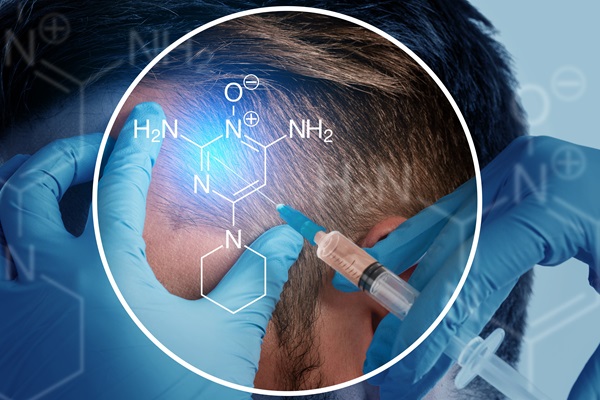
A hair doctor can recommend this over-the-counter medication for three types of hair loss. Hereditary hair loss is one of them. Minoxidil is available in foam or solution form. Applying it on the scalp may promote hair growth. The patient must first tell the hair doctor any of the following conditions:
Trying to get pregnant or already pregnant
Receding hairline
Breastfeeding
No hair loss in the family
Allergy to foods, preservatives, or medications
Sudden hair loss
Patchy hair loss
Idiopathic hair loss
Painful, red, swelling scalp
Remember, minoxidil is only for the scalp. Follow the instructions and talk to the hair doctor if there are any questions about them. Make sure that the scalp and hair are dry before using this medication for non-surgical hair restoration. Shampooing is not necessary after the application. Do not use it more often than recommended. Sharing this medication is not advisable.
Maintain the regular use of minoxidil. It may take about two to four months of continuous application before any improvement becomes visible. Continue using the product, or the new hair may fall out in three months. Stop using it if there is no hair growth after four months of continuous use.
Refrain from getting this medication in the mouth, eye, or nose. Rinse off right away with cool water if it comes in contact with these sensitive areas. Perform handwashing after using it. Refrain from applying on a sunburned or injured scalp. There could be noticeable hair texture or color after using minoxidil as part of one’s non-surgical hair restoration.
Topical tretinoin
Research reveals that this form of non-surgical hair restoration may treat male and female pattern baldness. Patients with androgenetic alopecia can use the maximum-strength variant. Studies show that tretinoin may also help with traction alopecia. This topical medication may also help people with stress-related hair loss.
Clinical data show that this non-surgical hair restoration may stimulate epithelial cell production. Topical tretinoin can also promote blood flow to this skin layer. This allows the hair growth stages to take place. A 2007 study shows that tretinoin (in the form of ATRA) can prolong the growth phase of hair as well.
The anagen or growth phase of hair can last up to about four years in normal adults. Individuals with androgenic alopecia often go through a shorter anagen phase and a longer telogen or resting phase. Extending the anagen phase can help maintain more hair on one’s scalp. It can also set different degrees of hair thickness.
People who use minoxidil may use tretinoin to enhance minoxidil’s absorption. This is possible by encouraging the release of sulfotransferase. Research shows that follicular sulfotransferase prolongs epithelial cell survival. It also pushes hair growth and enhances minoxidil absorption.
Clinical trials prove that a combination of 0.05% tretinoin and 2% minoxidil can increase the minoxidil absorption rate. This is currently effective on men suffering from male pattern baldness. Patients who are taking oral finasteride can also use topical tretinoin. This oral hormone medication prevents testosterone from becoming DHT (dihydrotestosterone). Research shows that DHT is the hormone that triggers hair loss.
The mentioned topical medications can help with your non-surgical hair restoration
Bringing back the thickness of your hair is the goal of any hair restoration treatment. If you do not want to have an invasive experience, a non-surgical hair restoration is for you. Using topical medications can help you achieve a thicker mane. This is achievable without the tedious recovery time. Working with your hair doctor will enable you to have a proper treatment experience.
A resting metabolic rate test measures how many calories the body burns at rest. Knowing that number changes how a weight loss plan should be built. The test is called indirect calorimetry. A person breathes into a mask while an analyzer reads the oxygen consumed and the carbon dioxide produced. Those readings reveal resting energy…
An Omega-3 Index test measures how much omega-3 actually reached the body's cells, something a fish oil label can never show. A supplement bottle lists what was swallowed. The test reports EPA and DHA, the two long-chain omega-3 fatty acids, as a percentage of the fatty acids in red blood cell membranes. Because those cells…
An hs-CRP test measures low-grade inflammation that a cholesterol panel cannot see. It helps explain why identical cholesterol results can lead to different heart outcomes. High-sensitivity C-reactive protein, written hs-CRP, is a protein made by the liver that rises with inflammation. Inflammation helps make an artery wall receptive to plaque. Cholesterol-carrying particles supply the material,…
The right P-Shot® candidate is identified through measurement, not age alone. The P-Shot®, short for Priapus Shot®, uses platelet-rich plasma (PRP) from a man's own blood to support tissue repair and new blood vessel formation. That process depends on the biology already in place. Three numbers shape how well it can work: free testosterone, hemoglobin…